
Superintelligence. Better Agents. Better Orchestration. Better Results.
We build the systems that give your organization an unfair advantage — purpose-built, deeply integrated, and designed for real-world complexity.
We build the systems that give your organization an unfair advantage — purpose-built, deeply integrated, and designed for real-world complexity.
Every week brings a new model, a new copilot, another point tool — adopted faster than anyone can govern. The result is sprawl: overlapping licenses, fragmented data, and teams toggling between a dozen half-useful assistants. Spend climbs, measurable productivity doesn't, and no one can point to the ROI. More AI has quietly made the enterprise slower.
Critical information is scattered across systems, formats, and departments — making it impossible for AI to deliver coherent insights.
A dozen overlapping point tools, each with its own login, data, and bill. Work fragments across them, spend piles up, and none of it compounds into real capability.
Connecting AI capabilities to existing workflows requires deep technical expertise and careful architectural planning.
General-purpose models generate plausible-sounding but incorrect outputs, creating liability in high-stakes environments.
Finding and retaining AI engineering talent is increasingly competitive, leaving many organizations unable to build in-house.
Sensitive enterprise data requires careful handling, governance, and compliance that most AI vendors don't prioritize.
The fix isn't one more tool. It's an operating layer that makes them cohere — governed, orchestrated, and aimed at outcomes. That's where superintelligence begins.

Like a master chef who selects the finest ingredients and applies expert technique, we carefully prepare your data, engineer precise tools, and deliver solutions with the attention they deserve.
We believe AI should be built with intention — not assembled from templates. Every model we fine-tune, every agent we deploy, and every pipeline we build is designed specifically for your organization.
Superintelligence isn't a single all-knowing model. It's the emergent property of an entire system — governed data, specialized agents, and orchestrated fleets — working as one cognitive organism.
AI works inside a human-run task, in a narrow, supervised role.
AI completes multi-step work end to end, using its own tools.
Specialist agents coordinate inside a single function.
Multiple clusters share memory, policy, and economics.
A meaningful share of the firm's work runs agentically, across functions.
The fleet optimizes itself — routing work, balancing cost, and reallocating models.
A fleet commander governs the whole system, bound to a codified LakeHouse.
Our claim is disciplined. We are not selling full superintelligence today. We are building the governed path toward it.
So how do we walk that path? It starts long before any agent goes live — by mapping your business at the highest possible fidelity, then translating that real-world complexity into executable, agentic process flows.

We decompose your business problem into atomic tasks, decision points, and data dependencies at granular detail.
Each task maps to an agent capability: orchestrator logic, sub-agent specialization, tool requirements, and skill assignments.
Related agents are grouped into clusters with shared context, coordinated by orchestrators tuned to your domain.
Clusters compose into a versioned fleet definition — auditable, reconfigurable, and governed from the LakeHouse control plane.
Each component is load-bearing. Remove any one, and you don't have superintelligence — you have a chatbot.
A growing repository of human-modeled, expert-calibrated AI agents — each tuned to a specific domain and available on demand.
No vendor lock-in. We mix the best models — Anthropic, OpenAI, Google, open-source — choosing the right engine for each task.
Standardized interfaces to external systems through the Model Context Protocol — with built-in security boundaries.
Reusable procedural knowledge — compiled organizational know-how that agents discover and load on demand.
A persistent values and persona layer with built-in reflection — the ethical compass behind every agent decision.
Our proprietary memory architecture gives agents persistent recall across sessions — learning and evolving over time.
Precision-crafted context windows fusing knowledge, state, tool outputs, and memory at exactly the right moment.
Policy enforcement, tool permission tiers, human-in-the-loop gates — safety that scales with capability.
Agents pause to think before they act. Plans are decomposed, reviewed, and verified end-to-end — keeping long-horizon work on the rails.
Human-in-the-loop partners that surface options, draft recommendations, and execute under your direction — keeping authority on consequential decisions where it belongs.
Composable capabilities — deep research, document drafting, code execution, autonomous orchestration — that bolt onto any agent and extend what the fleet can do.
Most AI platforms optimize for output. We optimize for judgment. Our Soul is a first-of-its-kind governance primitive — a persistent values layer that injects ethical guardrails and reflective reasoning into every agent decision.
Before a high-impact tool call, the agent pauses. It reflects. It evaluates intent against organizational values. This isn't a content filter bolted on after the fact — it's self-modeling woven into the architecture.

A consistent voice and value framework that reduces behavioral variance and encodes organizational boundaries, tone, and ethical principles across every run.
A dedicated reasoning step before high-stakes actions — surfacing uncertainty, evaluating intent, and creating an auditable trace of the agent's decision rationale.
Soul is always subordinate to safety policy. Governance layers enforce compliance after soul injection — ensuring no persona override can compromise security or compliance.
The market is flooded with companies racing to ship AI agents. They optimize for speed-to-demo. We optimize for something harder: systems that actually work when the stakes are real.
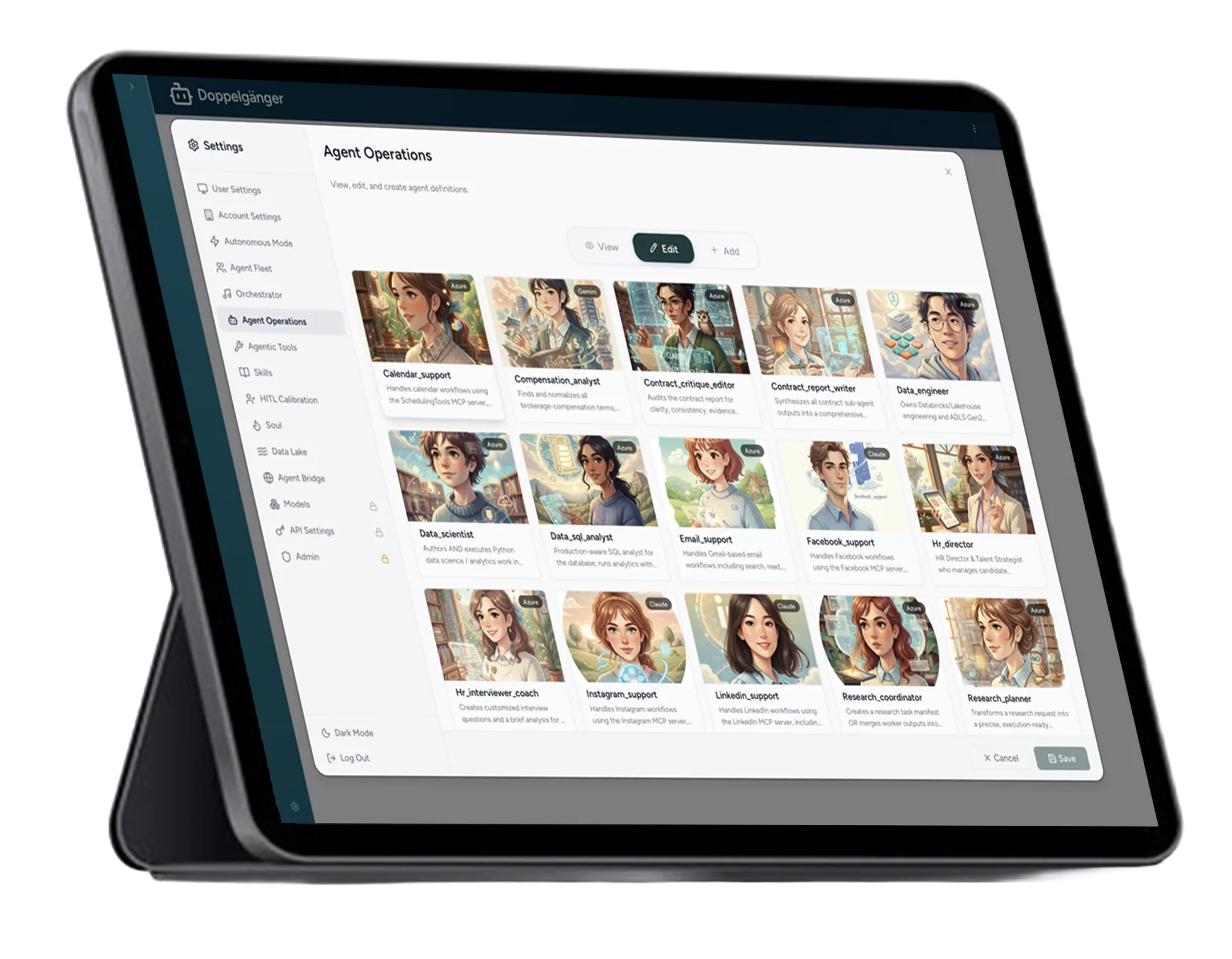
The key to superintelligence isn't building a bigger model — it's the ability to spawn highly capable sub-agents fast, each with specialized skills, private state, and tool access, then orchestrate them as a governed swarm.
We serve organizations where accuracy, compliance, and operational depth are non-negotiable.
Predictive maintenance, quality control, and supply chain intelligence.
Adaptive learning, knowledge synthesis, and institutional intelligence.
Secure intelligence processing, mission planning, and decision support.
Clinical decision support, research acceleration, and compliant data.
Fraud detection, regulatory compliance, and portfolio intelligence.
Developer tooling, automated QA, and intelligent infrastructure management.
Recipe optimization, supply chain tracing, and regulatory compliance.
Citizen services automation, policy analysis, and secure data management.
Market analysis, document processing, and portfolio optimization.
Route optimization, demand forecasting, and warehouse intelligence.
Talent matching, workforce analytics, and employee experience automation.
Guest experience personalization, revenue management, and operations intelligence.
The questions leaders ask when they first hear the word.
Enterprise superintelligence is an operating layer where a company's governed data, AI agents, and orchestration work as one system — delivering capability no single model, tool, or person could produce alone. It isn't one giant model; it's many specialized parts engineered to work in concert, built around your data and workflows.
Harness engineering is the discipline of building the scaffolding around AI models — context, tools, memory, guardrails, budgets, and verification — that turns raw model capability into reliable, accountable business systems. The model supplies the horsepower; the harness makes it pull in the right direction. It is ClearData AI's signature discipline.
No. Enterprise superintelligence describes systems that exceed what any individual could do across your specific workflows — by orchestrating models, data, and tools — not a claim about artificial general intelligence. The capability is measurable in your telemetry today, not speculative.
Assistant seats give every employee the same generalist helper. An operating layer puts specialized AI agents inside your actual workflows — grounded in your data, equipped with your tools, governed by your rules. The two aren't exclusive: assistants help individuals work faster, while superintelligence compounds across the whole organization.
No. Engagements begin with a short discovery and a scoped pilot that ships in weeks — a working system in your environment. Value is baselined and metered from day one, and the system expands only as the measured results justify it.
The organizations that move now will define the next era. Let's build yours.
Get Started