
AI Data Foundry
Where raw data is forged into AI-ready material — cleansed until it can be trusted, synthesized until it can be shared, and shaped until it can teach a model your business.
Every company can rent the same frontier models. The data you clean, create, and train them on is the only moat that's truly yours.
Raw data in. AI-ready assets out.
Most AI projects stall on the data, not the model. The AI Data Foundry is a production line for the three things every serious AI program needs — data you can trust, data you can share, and data that teaches. It runs on the governed LakeHouse, so every output arrives scored, versioned, and traced to its source.
Synthetic Data Generator
Realistic, related datasets and documents with zero real customers inside — privacy measured, never assumed.
See synthetic data →Intelligent Data Cleansing
AI Scrubbing strips the invisible characters and hidden watermarks AI-written text carries, flags personal data, and records where content came from.
See cleansing →LLM Fine-Tuning
Clean, versioned, documented training datasets in the exact format your training method needs.
See fine-tuning →All the realism. None of the risk.
Generate related, realistic datasets and documents for testing, demos, AI agent evaluation, and model training — without exposing a single real record.
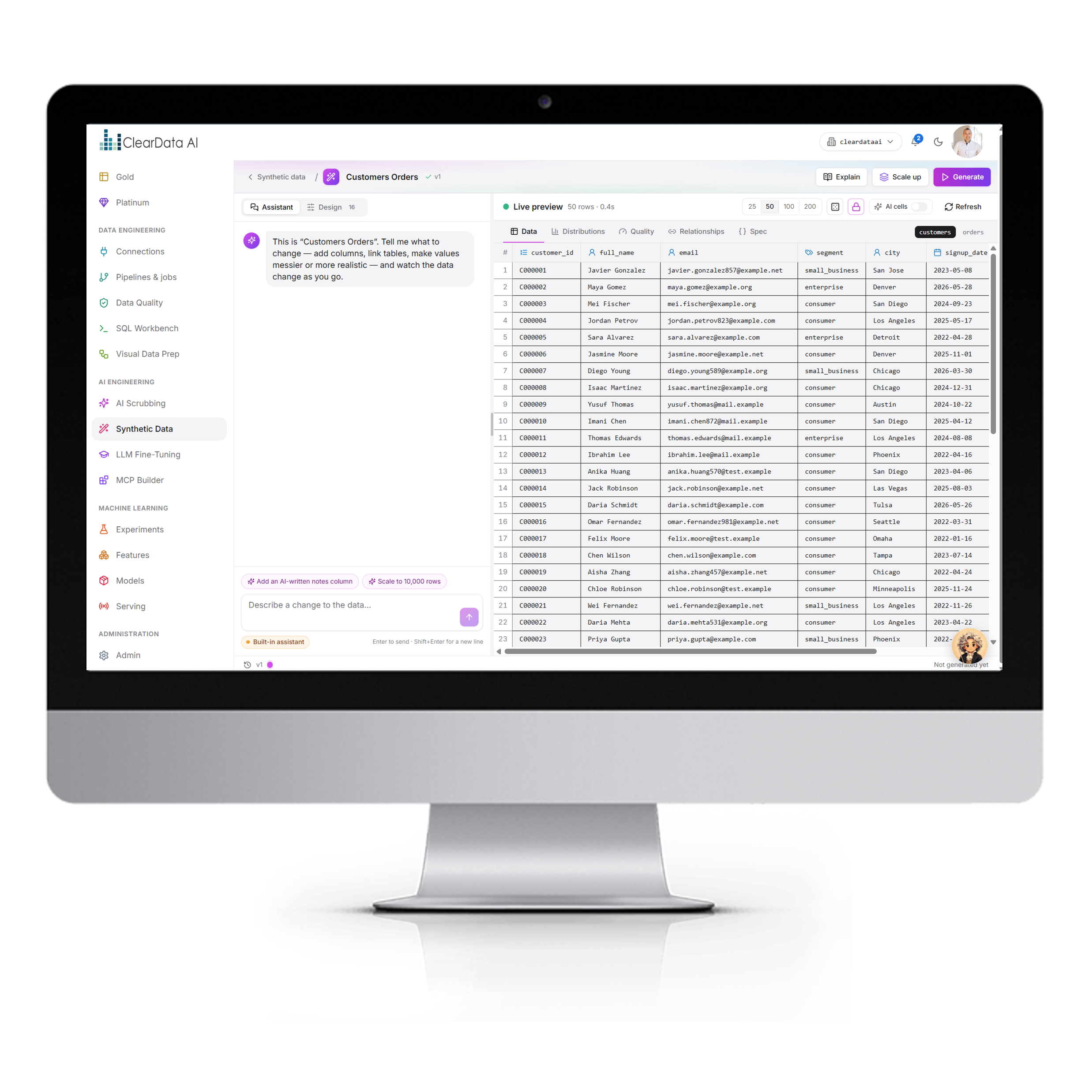
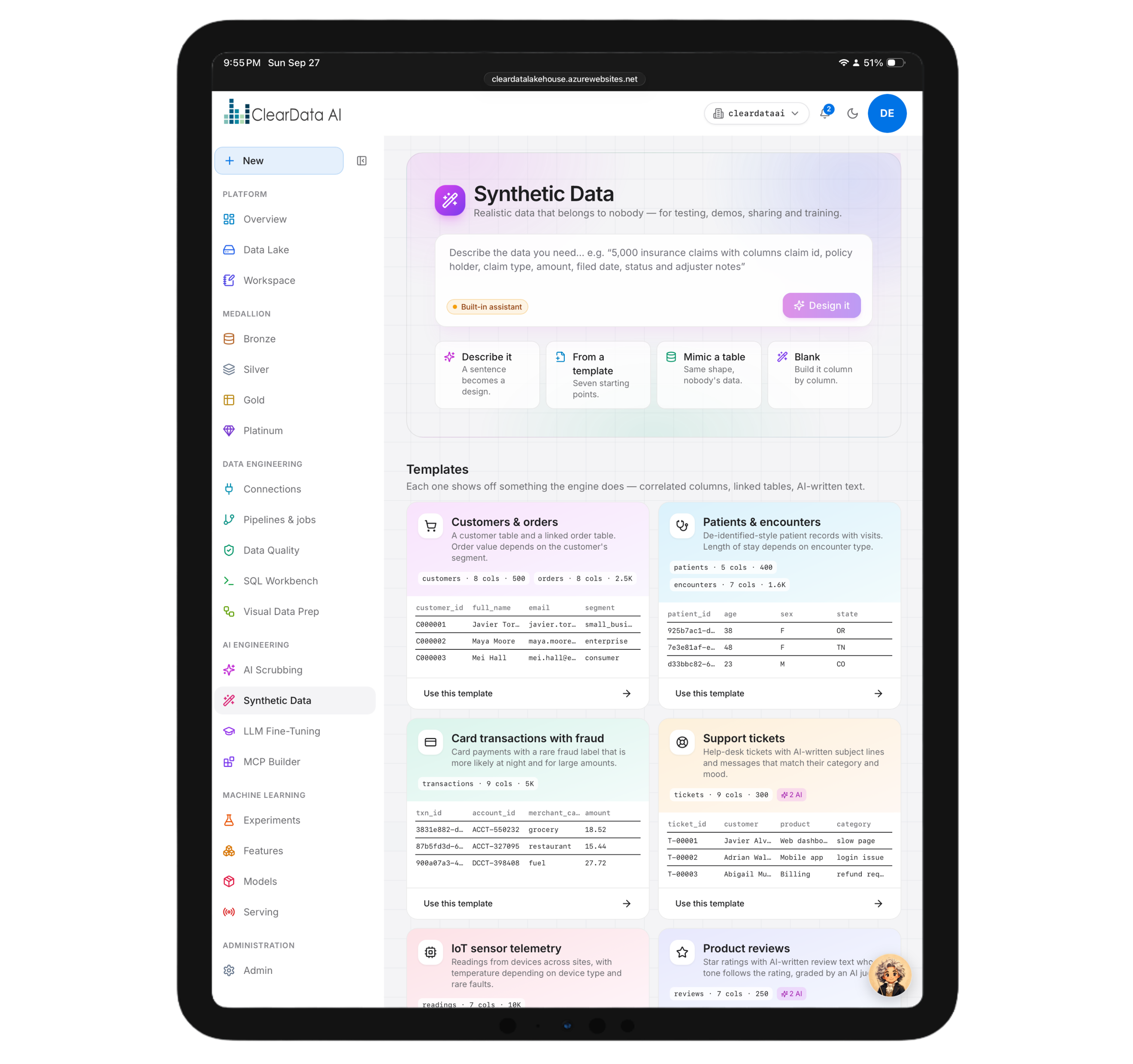
Describe what you need in a sentence, start from a template, mimic a real table, or begin blank. A split-screen studio pairs an AI designer with a live preview: every suggestion arrives as a change card you accept or reject, and every edit lands on a version timeline you can roll back.
- Customers & orders
- Patients & encounters
- Card transactions with fraud
- Support tickets
- IoT telemetry
- Product reviews
- HR employees
- Up to 8 linked tables with real relationships between them
- Mimic a real table — personal columns replaced, free text rewritten
- Rich column types — distributions, formulas, links, AI-written text, AI judges
- Deliberate mess — missing and invalid values for honest testing
- Fidelity, diversity, validity & privacy scored on every dataset
- Privacy you can prove — exact-copy and nearest-real-row checks
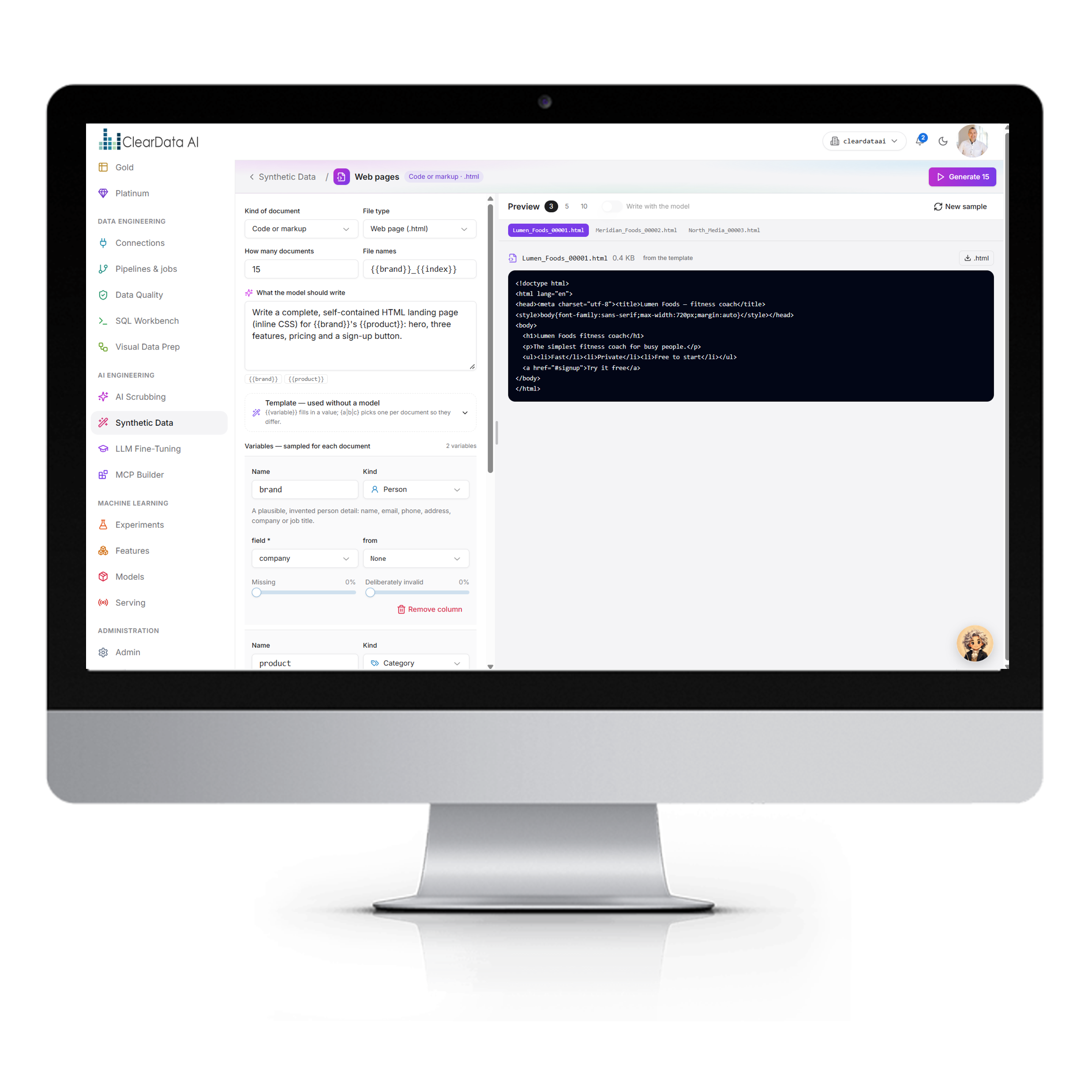
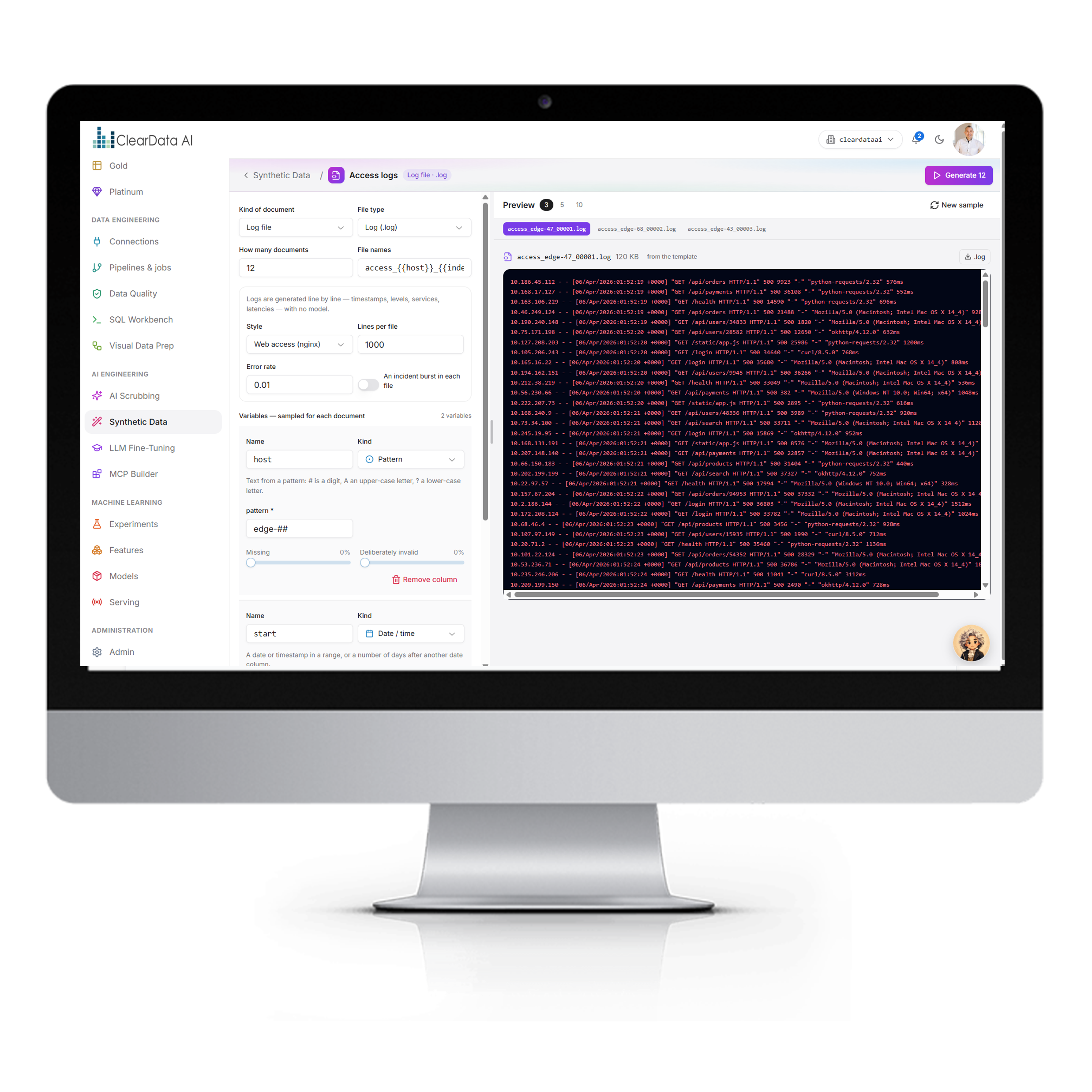
- Documents too — emails, call transcripts, contracts, decks, spreadsheets, code, and logs
- Scale to millions of rows — with no extra model calls
Millions of rows. Not millions of model calls.
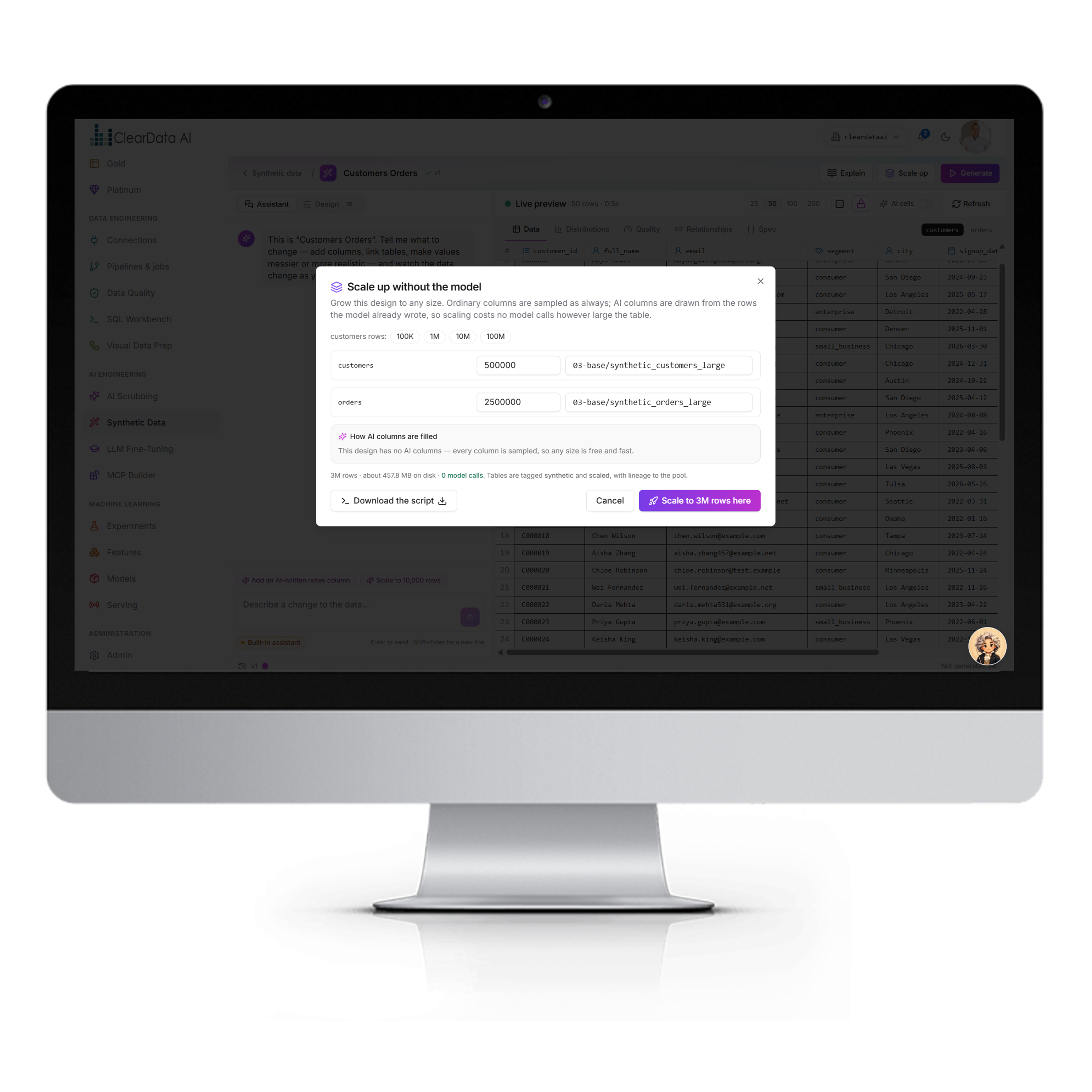
Design a dataset once at a comfortable size, then scale it to millions of rows. The AI writes its varied text a single time, and that becomes a pool. When the dataset grows, ordinary columns are sampled as usual and every AI-written value is drawn from the pool — from a row with the same labels, with the new row's own details swapped in.
- No extra model calls, however large the table
- See the plan first — including a warning if the pool is too small to stay varied
- Linked tables stay in proportion as the first table grows
- Run it as a job that writes in chunks, or download a kit to run on any machine
Not just tables — realistic documents, too.
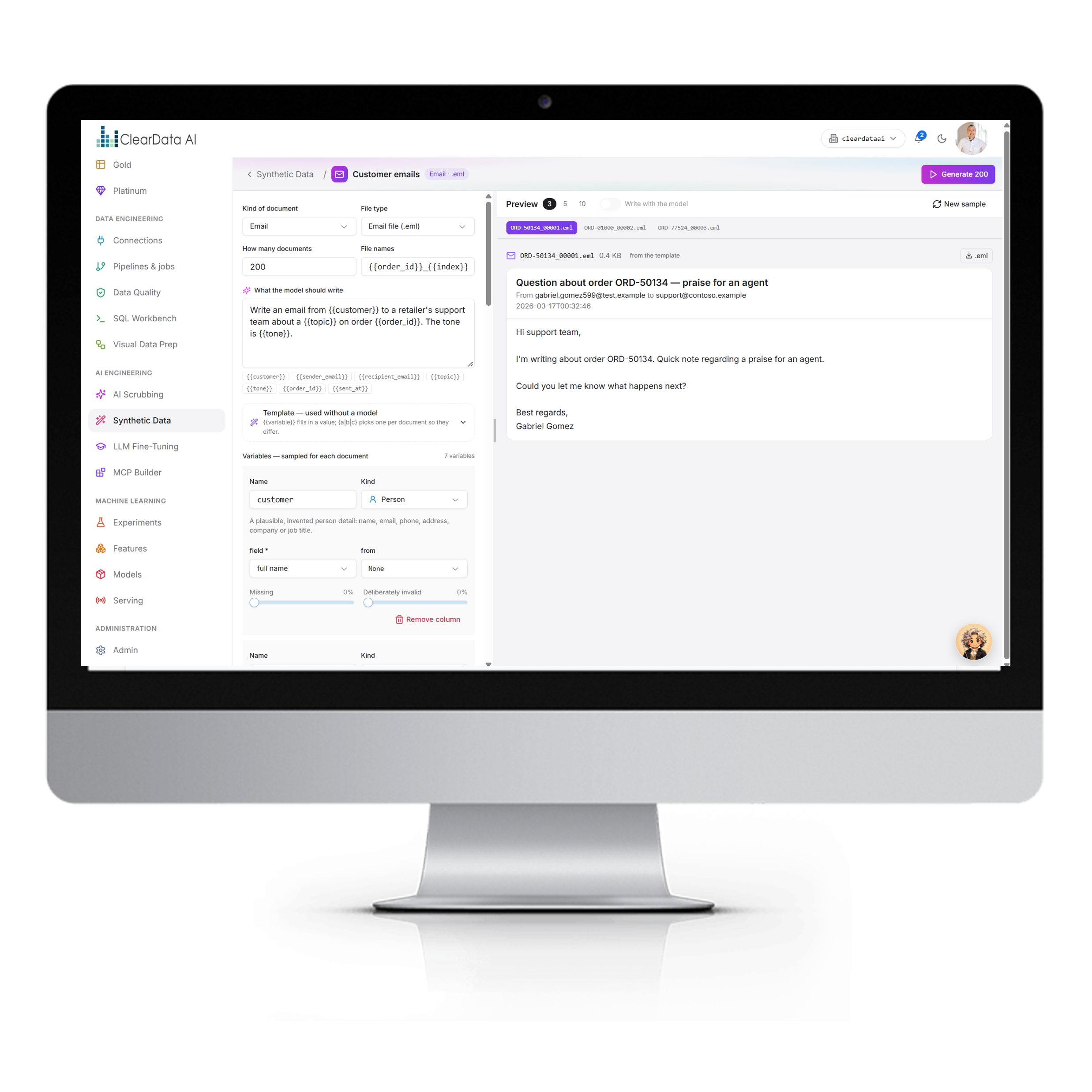
AI agents and search systems need unstructured content to learn from and be tested against. The generator writes complete files — emails, call transcripts, contracts, decks, spreadsheets, code and markup, and logs — each saved as a real file, with a table that indexes them all.
Scrub what you can't see.
AI-written and copy-pasted text is quietly polluting enterprise data. AI Scrubbing finds what the eye misses, cleans it, and tells you honestly what it can and can't conclude.
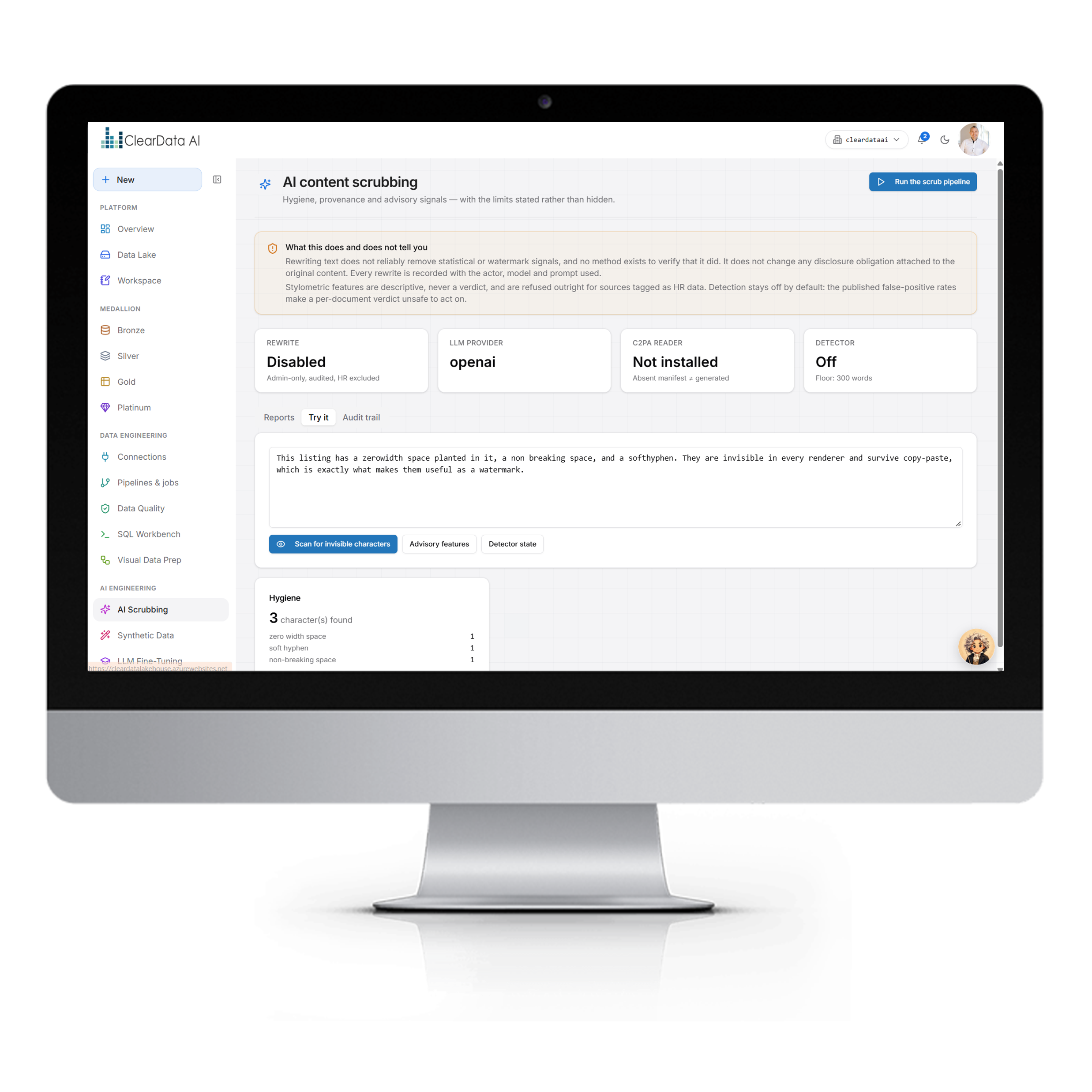
Generated content often carries invisible baggage — zero-width spaces, soft hyphens, byte-order marks, direction-control codes, and hidden watermark characters. They break search, joins, deduplication, and every model you train downstream. AI Scrubbing normalizes them across your tables, records provenance where files carry it, and reports exactly what changed, column by column.
Honest by design. AI-detector verdicts stay off by default, because their false-positive rates make a ruling on one document unsafe. A missing provenance record never means “machine-written.” Writing-style signals are refused outright on HR data, and any rewrite requires an administrator, an organization-level switch, and an audit record.
- Invisible-character hygiene with per-column counts by kind
- Hidden watermark removal — direction controls and variation selectors
- Raw value retention available when you need the original
- Content provenance — reads content credentials (C2PA) where present
- Personal-data detection — emails, phones, national IDs, bank and card numbers
- Advisory writing signals — burstiness, vocabulary, hedging — clearly labelled
- Try it — paste a passage and scan it before touching a table
- Full audit trail — every step, actor, source, and target
Teach a model your domain.
Turn cleansed and synthetic data into training-ready datasets for fine-tuning large language models — in the right shape, with the noise taken out.

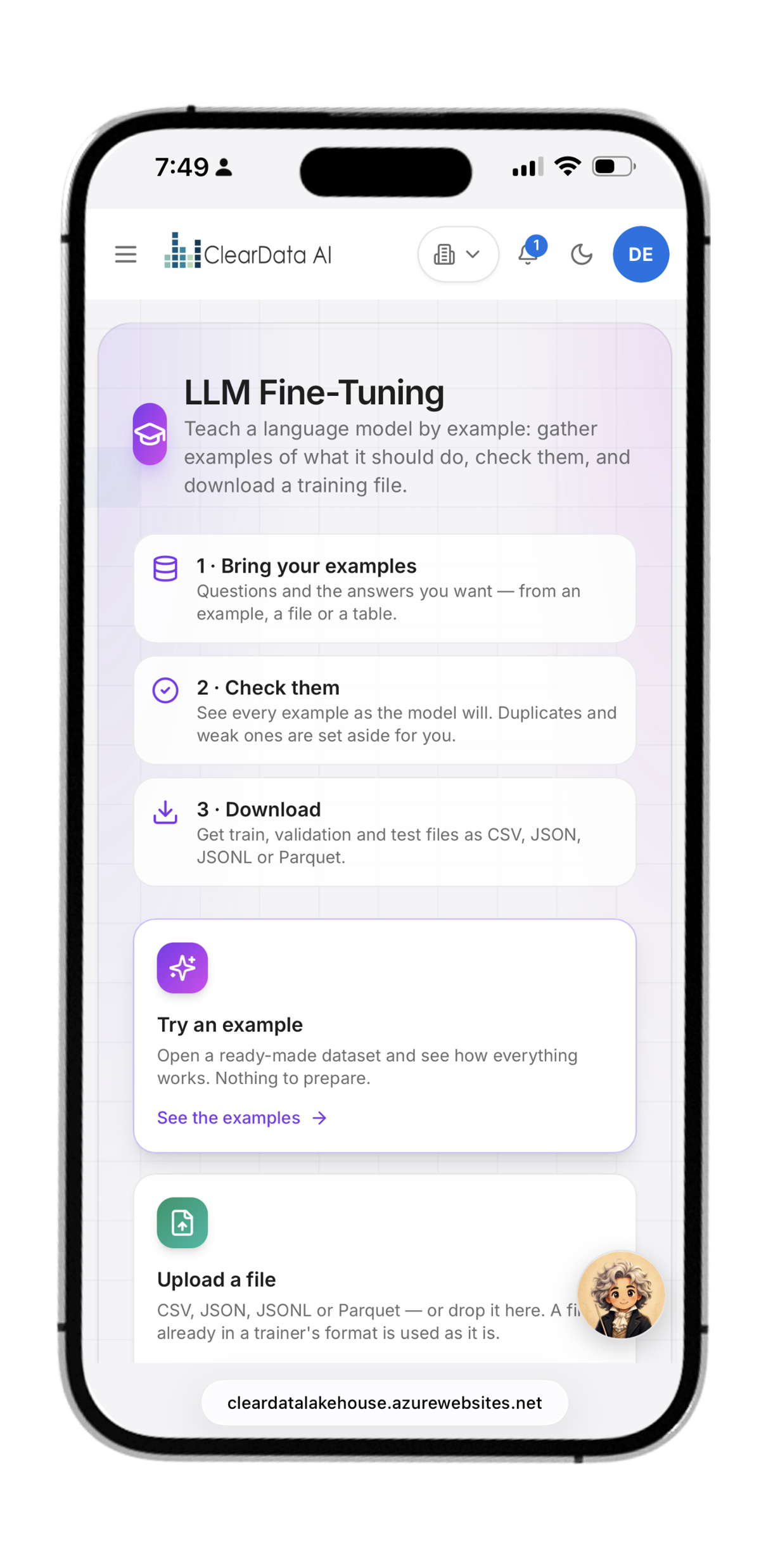
Pick the format your training method expects, start from an example shaped like a well-known public dataset, switch on the clean-up you need, and review what was set aside — each exclusion comes with a plain-language “why.” Export train, validation, and test splits ready for standard open-source trainers, on the compute you choose.
- Near-duplicate removal, plus low-quality and toxicity filters
- Personal-data screening before anything is exported
- Leakage protection keeps evaluation questions out of training
- Token limits & language filters for tight, consistent sets
- Versioned exports in JSONL, CSV, JSON, or Parquet
- Dataset cards aligned with EU AI Act data-documentation expectations
Forged here. Put to work everywhere.
Everything the Foundry produces lands back in the same governed data lake that powers the rest of the platform — ready for your agents, your analysts, and your models.
Proving agents before production
Realistic, risk-free data and documents let you rehearse agent workflows, demo to stakeholders, and stress-test edge cases without touching a real customer.
Grounding for AI agents
Clean, provenance-tagged text flows into the LakeHouse's knowledge layer — so the documents your AI Agent Fleet retrieves and cites are free of hidden noise.
Specialists that know your work
Curated datasets teach smaller, faster models your language and judgment — models your agents can call for routine work, including on hardware you own.
From first table to trained model
Foundry engagements start small and prove value early — one dataset, one use case, measured from day one.
Assess
We profile the sources one use case needs and baseline their quality, so the starting point is a number, not a guess.
Forge
Content is scrubbed, synthetic companions are generated where real data can't travel, and training sets take shape.
Prove
Scores, privacy metrics, and evaluation results show what improved — before anything reaches production.
Operate
Scrubbing runs on schedule, datasets are versioned, and your team owns a repeatable line it can extend on its own.
The AI Data Foundry, explained
Turning raw data into AI-ready assets.
An AI data foundry is the process — and the tooling — that turns raw enterprise data into assets AI can safely use. The ClearData AI Data Foundry does it in three stages: intelligent data cleansing so the data can be trusted, synthetic data generation so it can be shared and scaled, and fine-tuning dataset curation so it can teach a model your domain.
It removes what people can't see: zero-width spaces, soft hyphens, byte-order marks, direction-control codes, and hidden watermark characters that AI-written and copy-pasted text often carries. It also flags personal data and records content provenance where files carry it. Every change is counted per column and logged, and writing-style signals are offered only as advisory — never as a verdict.
Use synthetic data whenever real data is too sensitive, too scarce, or too clean to test with — for development and QA environments, vendor demos, AI agent testing, and rare events such as fraud that real data barely contains. Keep real data for final validation and production. The Foundry measures privacy and fidelity so you know how far each synthetic dataset can travel.
A good fine-tuning dataset is in the right format for the training method, free of duplicates, low-quality and toxic examples, scrubbed of personal data, and strictly separated from the test questions used to evaluate it. It should also be versioned and documented, so you can explain exactly what the model learned from — which regulations such as the EU AI Act increasingly expect.
Forge your first AI-ready dataset
Bring one messy table or one model you want to specialize. We'll show you what the Foundry makes of it.
Get Started